
Key Takeaways
- Cortisol Storage: Learn how the body physically traps stress in the fascia and psoas muscle.
- Pandiculation vs. Stretching: Why traditional stretching fails to lower cortisol and how pandiculation retrains the brain.
- The Psoas Connection: Specific movements to unlock the ‘muscle of the soul’ where fight-or-flight lives.
- Vagus Nerve Activation: Techniques to instantly switch from sympathetic (stress) to parasympathetic (rest).
- Daily Protocols: A structured morning and evening routine to prevent cortisol spikes.
- Emotional Release: Understanding ‘somatic release’ phenomena, including tearing or shaking.
You feel it in your jaw the moment you wake up. You feel it in the tightness of your hips after a long meeting. It’s not just ‘stress’—it is a physiological blockade. For millions of people, high cortisol isn’t just a hormonal imbalance; it is a physical state of being stuck in survival mode. You have tried talk therapy, meditation, and medication, yet the anxiety remains trapped in your tissues.
This is the missing link.
Your nervous system is holding onto a ‘freeze’ response, and no amount of positive thinking can release a muscle that your brain has forgotten how to relax. Somatic exercises for cortisol do not ask you to think your way to calm; they ask you to move your way there. By engaging the sensorimotor cortex, these 13 specific techniques bypass the analytical mind to communicate directly with your nervous system, flushing cortisol and releasing stored trauma. Here is your comprehensive guide to resetting your body’s alarm system.
The Cortisol-Trauma Loop: Why You Can’t “Think” Your Way Out of Stress
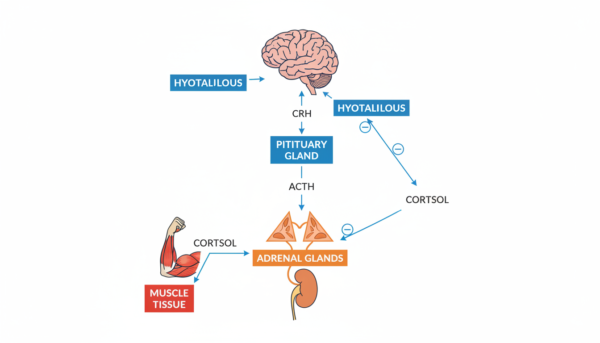
Cortisol is often demonized, but it is essential for survival. It wakes you up and fuels you during danger. The problem arises when the danger passes, but the body never receives the ‘all clear’ signal. This is the Cortisol-Trauma Loop.
When a traumatic or high-stress event occurs, your muscles contract to protect you (the startle reflex). In a healthy nervous system, these muscles relax once the threat is gone. However, in modern life, the ‘threat’—emails, traffic, financial worry—is constant. Your brain eventually stops noticing the tension, a condition known as Sensory Motor Amnesia (SMA).
The Physiology of Stored Trauma
- The Sympathetic Dominance: Your body remains in a low-grade ‘fight or flight’ mode.
- Fascial Restriction: The connective tissue shrinks-wraps around tense muscles, restricting blood flow and trapping inflammation.
The Feedback Loop: Tense muscles send signals to the brain that danger is present, causing the brain to release more* cortisol, which keeps muscles tense.
Somatic exercises break this loop not by stretching (which triggers a stretch reflex) but by re-educating the nervous system to voluntarily release the contraction.
Identifying “The Freeze”: Physical Signs Your Nervous System is Stuck
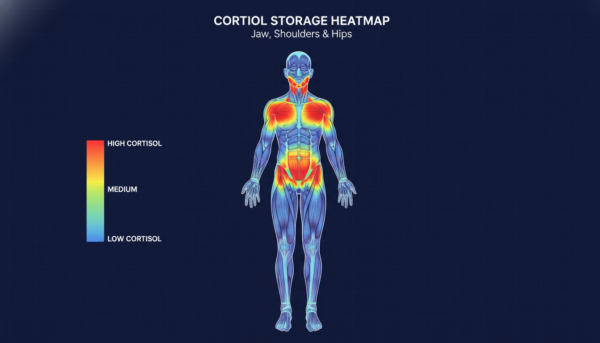
Before you can release cortisol, you must identify where it is hiding. High cortisol manifests physically long before it shows up in blood work. If you are ‘living in your head,’ you may be disconnected from these bodily signals.
The Somatic Checklist
| Body Area | Symptom of High Cortisol | Somatic Implication |
|---|---|---|
| Jaw/Neck | TMJ, grinding teeth, tightness | Suppressed anger or inability to speak truth. |
| Shoulders | Elevated posture (Ear-muffs) | Defensiveness, protecting the heart. |
| Diaphragm | Shallow breathing, rib constriction | Constant anxiety, ‘fight or flight’ activation. |
| Hips/Psoas | Anterior pelvic tilt, lower back pain | The ‘run away’ reflex is perpetually engaged. |
| Gut | Bloating, IBS, ‘Cortisol Belly’ | Digestion shuts down during stress states. |
If you identify with three or more of these signs, your nervous system is likely trapped in a functional freeze state. Somatic exercises aim to thaw this freeze.
Pandiculation vs. Stretching: The Mechanism of Release
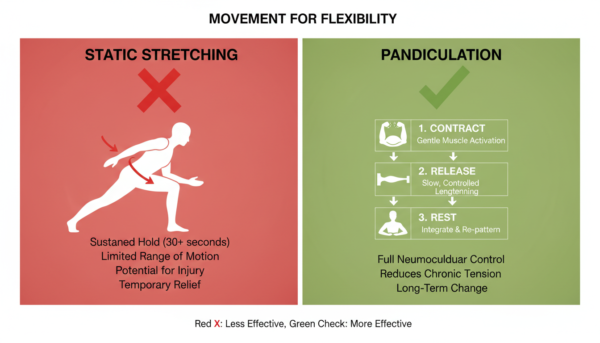
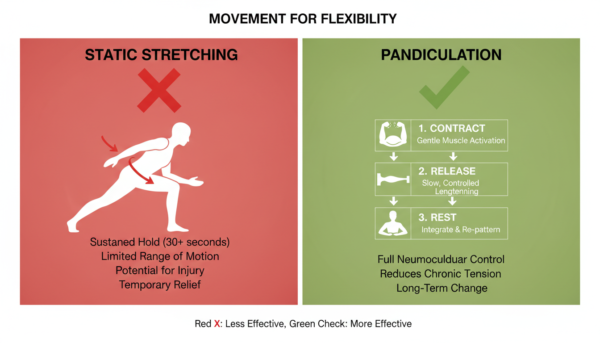
Most people try to fix tight muscles by pulling on them (static stretching). This often backfires. When you aggressively stretch a tight muscle, the myotatic reflex kicks in, causing the muscle to contract against the stretch to prevent tearing. This does not lower cortisol; it often increases physical stress.
Pandiculation is the somatic alternative. It is the natural stretching action animals do when they wake up. It involves three distinct steps:
1. Contraction: You voluntarily contract the tight muscle even further (shortening it).
2. Slow Release: You very slowly and consciously lengthen the muscle (eccentric contraction).
3. Rest: You completely relax the muscle, allowing the brain to integrate the new length.
This process ‘resets’ the gamma loop feedback system between the muscle and the brain, effectively lowering the resting tone of the muscle and reducing the cortisol signals sent to the brain.
Exercise 1: The Psoas Release (The Muscle of the Soul)
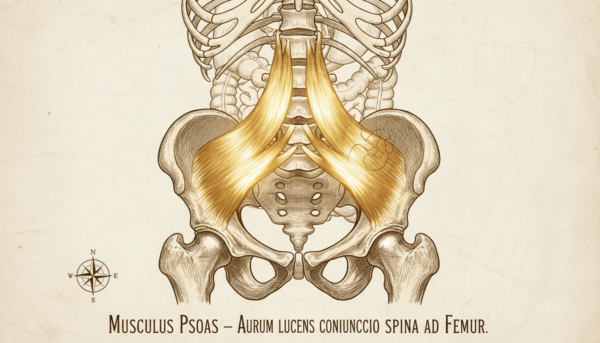
The Psoas Major is the only muscle connecting your spine to your legs. It is the primary muscle of the fight-or-flight response. When you are startled, the psoas contracts to pull you into a fetal ball. Chronic cortisol keeps the psoas short, pulling on the lumbar spine and compressing the adrenals.
How to Perform the Psoas Release
1. Setup: Lie on your back, knees bent, feet flat on the floor. Place your hands on your lower abdomen.
2. The Arch: Inhale and gently arch your lower back away from the floor (tilting pelvis forward). Feel the lower back muscles contract. Do not force.
3. The Flatten: Exhale and slowly flatten your lower back into the floor (tucking pelvis). Feel the abdominal muscles contract.
4. The Release: Slowly release the contraction until your spine is in neutral. Do nothing for 10 seconds.
5. Repetition: Repeat 10 times, moving slower with each repetition. Focus entirely on the sensation of the hip flexors letting go.
Why it works: This rocking motion gently pumps the psoas and encourages the lumbar muscles to drop their protective guarding.
Exercise 2: The Vagus Nerve Ear Massage Reset
The Vagus Nerve is the commander of the parasympathetic nervous system (rest and digest). A branch of the Vagus nerve, the auricular branch, surfaces in the ear. Stimulating this area can send an immediate signal to the brain to lower heart rate and cortisol.
The Technique
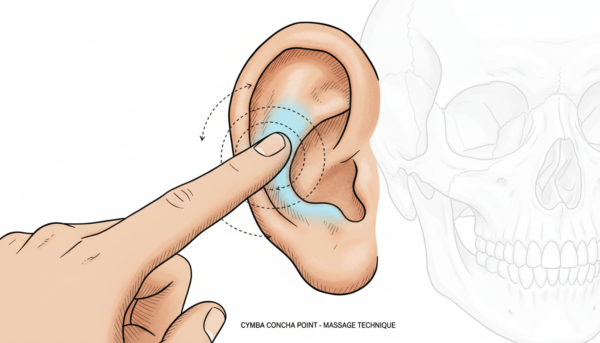
1. Locate: Place your index finger in the cymba concha (the small depression just above the ear canal opening).
2. Pressure: Apply gentle, consistent pressure. You can move in tiny circles.
3. Pull: Gently pull the earlobe down and out while maintaining the massage.
4. Eye Movement: While massaging the right ear, look as far to the right as possible with your eyes (keep head still). Hold until you swallow, sigh, or yawn.
5. Switch: Repeat on the left ear.
The ‘Sigh’ Sign: A spontaneous sigh or yawn indicates a ‘ventral vagal shift,’ meaning your body has successfully down-regulated the stress response.
Exercise 3: The Arch and Flatten (Somatic Back Relief)
While similar to the Psoas release, this exercise focuses specifically on the Green Light Reflex (the muscles of the back body that contract to propel us forward). Chronic ‘doers’ and high-achievers often have a locked back.
Step-by-Step
1. Lie Down: Supine position, knees bent.
2. Inhale/Arch: Roll your tailbone into the floor, arching the lower back. Squeeze the shoulder blades slightly together. This mimics the stress posture.
3. Exhale/Flatten: Slowly release the arch. Imagine your spine melting into the floor one vertebrae at a time.
4. The Curl: As you flatten, let your head nod slightly forward and your shoulders round slightly.
5. Neutral: Return to complete stillness.
This movement addresses the entire posterior chain, signaling to the brain that it is safe to stop ‘pushing’ through life.
Exercise 4: The Standing Shake-Off (Tremoring)
Animals in the wild literally ‘shake off’ trauma after escaping a predator. Humans suppress this urge to look composed. This suppression traps the kinetic energy of the stress hormone cycle in the fascia.
Neurogenic Tremoring Protocol
1. Stance: Stand with feet hip-width apart, knees slightly bent.
2. Bounce: Begin to bounce gently at the knees. Keep your heels on the ground.
3. Loose Arms: Let your arms hang completely dead-weight. Shake your hands.
4. Build Momentum: Increase the speed of the bounce. Allow the vibration to travel up to your shoulders and neck.
5. Vocalize: Let out a sound—a low hum or a sigh—while shaking.
6. Duration: Continue for 1-3 minutes. Stop and stand perfectly still to feel the ‘buzzing’ sensation of increased circulation and energy release.
This exercise is highly effective for acute stress (e.g., right after a difficult phone call).

Exercise 5: The Occipital Release (Neck Tension Hack)
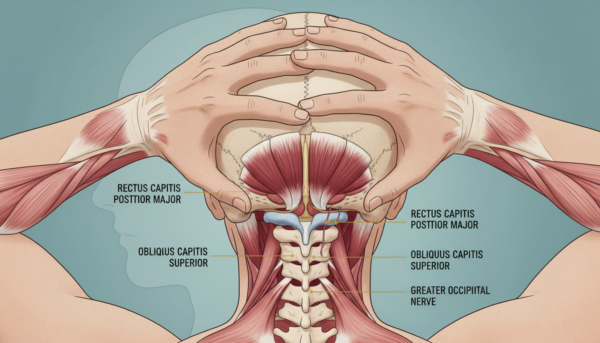
The suboccipital muscles at the base of the skull are densely packed with proprioceptors. They coordinate with your eyes. When you stare at screens (visual tunnel vision), these muscles lock up, triggering tension headaches and cortisol spikes.
The Release
1. Setup: Lie on your back. Interlace fingers behind your head, creating a hammock for your skull.
2. Lift: Gently lift your head an inch off the floor using your arms (neck muscles must remain passive).
3. Resistance: Press your head back into your hands while simultaneously pulling your hands forward. Create an isometric contraction. Hold for 5 seconds.
4. Slow Release: excruciatingly slowly, lower your head back to the floor.
5. Scan: Once down, slowly roll your head left and right. It should feel like it is floating on oil.
This disconnects the eye-neck tension loop associated with digital burnout.
Exercise 6: Diaphragmatic Scooping for Cortisol Belly
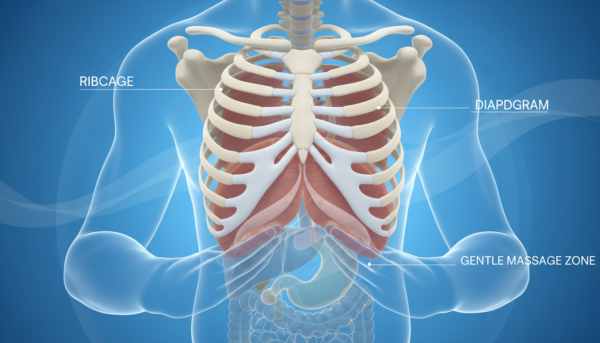
When we are stressed, we reverse breathe (chest breathing). The diaphragm freezes, and the fascia around the gut tightens, leading to ‘cortisol belly’ and poor digestion. This exercise manually releases the diaphragm.
The Scoop
1. Lie Down: Knees bent, feet flat.
2. Hand Placement: Place fingertips just under the bottom of your rib cage.
3. Exhale: Blow all the air out of your lungs.
4. Scoop: While your lungs are empty, gently curl your fingers under the ribs (do not cause pain). You are massaging the attachment of the diaphragm.
5. Inhale: As you inhale, resist the pressure of your fingers slightly, expanding the ribs laterally.
Releasing the diaphragm signals the Vagus nerve (which passes through it) that the immediate danger is over.
Exercise 7: The Seated Pelvic Clock
You don’t need to lie down to reduce cortisol. This can be done at your office desk. The pelvic clock mobilizes the hips and lower back, breaking the stagnation of sitting.
Office Somatics
1. Sit: Sit on the edge of your chair, feet flat.
2. Imagine a Clock: Your pelvis is the clock face. 12 o’clock is your belly button; 6 o’clock is your tailbone.
3. 12 to 6: Tilt pelvis back (slumping) to 12, then arch forward to 6.
4. 3 to 9: Lift one hip bone (3), then the other (9).
5. Rotation: Smoothly connect the dots, rolling your pelvis in a circle. 12-3-6-9.
6. Reverse: Go counter-clockwise.
This movement lubricates the hip joints and prevents the ‘stuckness’ that accumulates during work hours.
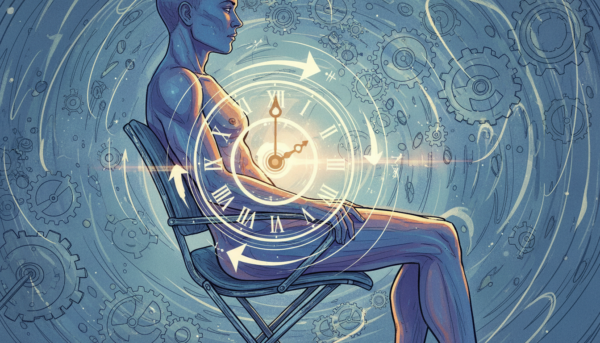
Exercise 8: The Squeeze and Release (Progressive Relaxation)
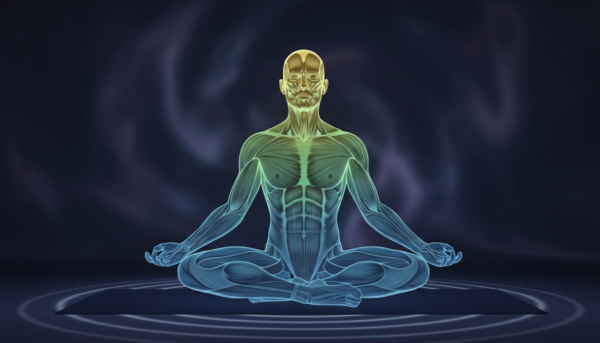
This is a classic somatic technique used in clinical settings to treat anxiety and insomnia. It teaches the brain the difference between tension and relaxation through extreme contrast.
The Protocol
1. Toes: Curl your toes tight. Hold for 5 seconds. Release completely.
2. Legs: Flex your calves and thighs. Hold. Release.
3. Glutes/Belly: Squeeze buttocks and abs. Hold. Release.
4. Hands/Arms: Make fists, tense biceps. Hold. Release.
5. Face: Scrunch your eyes, purse lips, furrow brow. Hold. Release.
6. Full Body: Tense everything at once. Hold for 10 seconds. Release and lie still for 1 minute.
By maximizing tension before releasing, you override the body’s habit of holding ‘medium’ tension levels.
Scheduling Calm: A Sample 10-Minute Daily Somatic Routine
Consistency trumps intensity. Doing 10 minutes of somatic work daily is more effective for lowering cortisol than a 90-minute session once a month. Here is a balanced protocol.
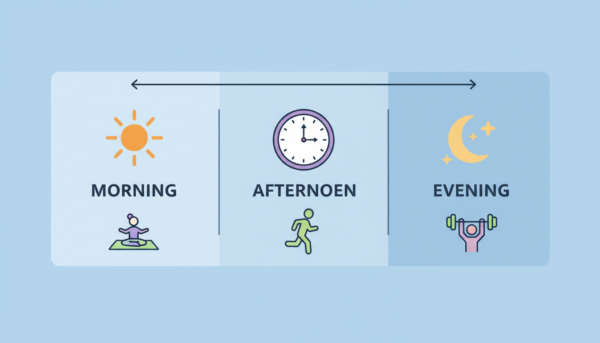
Morning: The Wake-Up (3 Minutes)
- Full Body Pandiculation: Stretch arms overhead, tighten, and slow-release (3 reps).
- Standing Shake-Off: 1 minute to wake up the nervous system.
Afternoon: The Desk Reset (2 Minutes)
- Seated Pelvic Clock: 1 minute.
- Vagus Ear Massage: 1 minute.
Evening: The Cortisol Flush (5 Minutes)
- Psoas Release: 2 minutes.
- Arch and Flatten: 2 minutes.
- Diaphragmatic Breathing: 1 minute.
Perform the evening routine right before bed to improve deep sleep and growth hormone production.
Troubleshooting: Why You Might Feel Worse Before Better
As you begin somatic exercises for cortisol, you may experience ‘Somatic Release.’ This can be confusing if you expect instant bliss.
The Healing Crisis
- Emotional Tears: Releasing the psoas often triggers unexplained crying. This is old grief leaving the body.
- Nausea: As the Vagus nerve activates gut motility, you might feel temporary nausea.
- Twitching: Muscles may spasm as they discharge stored energy.
- Fatigue: Your body may suddenly demand sleep as it switches out of survival mode.
Advice: These are signs of success, not failure. Drink water, rest, and allow the emotions to pass without analyzing them. If sensations are overwhelming, reduce the range of motion and proceed slower. You are retraining a lifetime of habits; patience is the key to the cure.
Frequently Asked Questions
How long does it take for somatic exercises to lower cortisol?
Immediate effects like lower heart rate and easier breathing can be felt within 5-10 minutes. However, resetting chronic high cortisol levels typically requires 3-4 weeks of consistent daily practice.
Can somatic exercises release emotional trauma?
Yes. Trauma is often stored as kinetic energy in the fascia and muscles (specifically the psoas). Somatic movements can release this energy, often resulting in emotional release like crying or shaking.
Are somatic exercises better than yoga?
They are different. Yoga focuses on stretching and strength. Somatics focuses on retraining the brain-to-muscle connection to release involuntary tension. For cortisol specifically, somatics is often more effective for those who are ‘too stiff’ for yoga.
Why do I shake during somatic exercises?
Shaking, or neurogenic tremors, is the body’s natural mechanism for discharging high levels of adrenaline and cortisol. It is a sign that the nervous system is down-regulating from a stress state.
Can I do somatic exercises in bed?
Absolutely. Many somatic movements, like the Arch and Flatten or Psoas Release, are perfect for doing in bed before sleep to ensure a restful night.
Is it normal to feel pain during these exercises?
No. Somatic exercises should be pain-free. If you feel pain, you are pushing too hard or moving too fast. Make the movement smaller and slower until it is comfortable.
How often should I do somatic exercises?
Daily is best. Because you are retraining the brain, frequent, short sessions (10-15 minutes) are more effective than infrequent long sessions.
What is the best time of day for somatic exercises?
Morning is good for mobility, but evening is best for lowering cortisol levels accumulated throughout the day and preparing the body for deep sleep.
You might also like:- Somatic Exercises for Cortisol Belly: The Science of Melting Visceral Fat Through Nervous System Regulation
Discover more from innerspiritglow
Subscribe to get the latest posts sent to your email.

[8980]ph367 Online Casino: The Best Online Gambling Site in the Philippines for Slot Games and Easy GCash Registration. Experience ph367 online casino, the best online gambling site in the Philippines. Play top ph367 slot games with easy ph367 gcash registration and secure ph367 login philippines access. Join now for the ultimate gaming experience and big wins! visit: ph367
Finally found a site that actually delivers on its promises. The app runs super smoothly on my phone and I love how fast the withdrawals are processed. It feels like a community where real players get treated right. Give it a try and you will see what I mean. inaagame
I joined a while ago and have not looked back since. The game selection is massive and everything runs incredibly smoothly on my phone. I really value how secure they make the payment methods and how fast the withdrawals process. Definitely check out bdjeeta7
Finding a trustworthy betting partner can be tricky but this platform consistently keeps its promises. The welcome bonuses are straightforward and the game selection covers all the classics I enjoy. I feel safe and entertained every time I log in. Play around here vnmmoobet
The energy on this site is awesome. The games are exciting and the promotions are always updated. Go to phfierylogin
The graphics are amazing and the gameplay is very addictive. I’ve had some great wins here lately and the withdrawal process was surprisingly easy. Love bdg999game!
Finally found a place where the odds are actually fair. The variety of options is impressive and the support team is very helpful. Give aposta1real a shot!
Great vibe and the games are always updated. I appreciate the transparency with the odds. bd8e884 is a winner in my book.
The variety of games is insane! I love how everything is organized and the customer support is actually helpful. Big thanks to impor88 for the great service.
[5387]Kingbet86 – Đăng nhập tải app và hướng dẫn chơi baccarat,Truy cập kingbet86 để trải nghiệm sòng bài trực tuyến. Hướng dẫn nạp tiền casino qua Momo nhanh chóng và mẹo quay slot nổ hũ dễ trúng. Tham gia ngay hôm nay! visit: kingbet86