
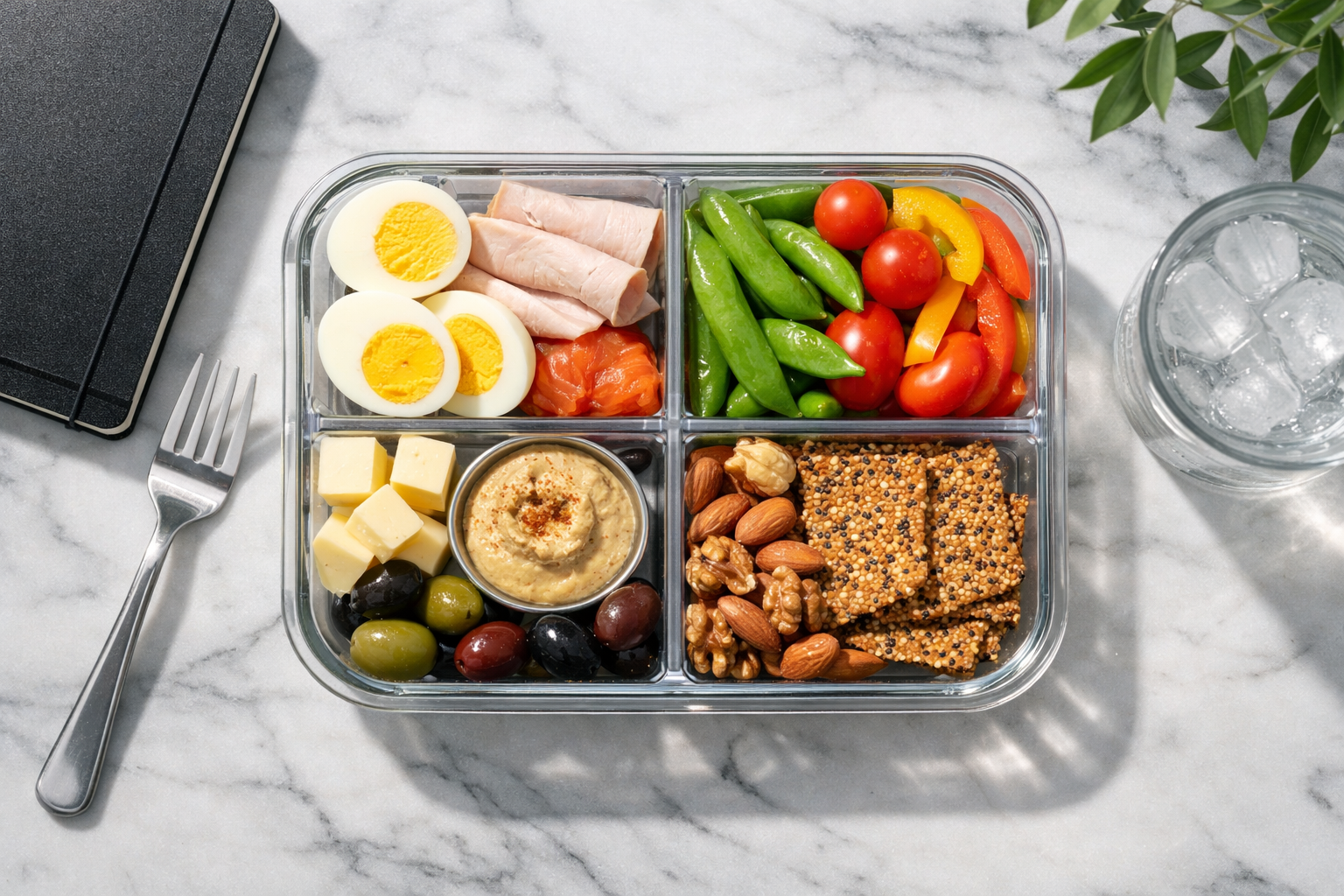
Key Takeaways
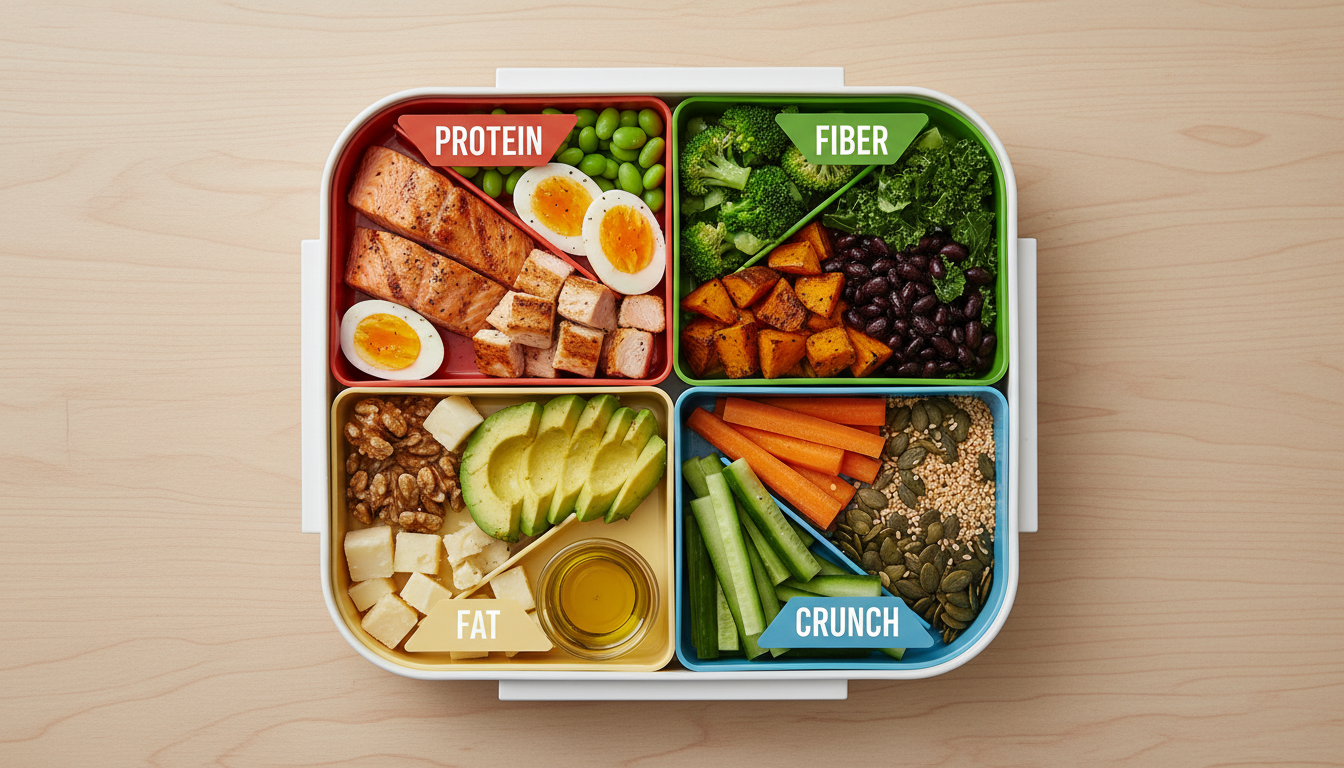
- The 4-Quadrant Rule: A nutritionally complete bento must balance Protein, Fiber-Rich Carbs, Healthy Fats, and the “Crunch Factor” for satiety.
- Cost Efficiency: Switching to DIY Adult Lunchables saves the average worker over $2,400 annually compared to daily takeout.
- Container Science: Glass containers offer the best longevity and safety, but stainless steel provides the superior weight-to-durability ratio for commuters.
- Safety First: Perishable proteins must be kept below 40°F; we analyze the specific ice-pack density required for 4+ hour commutes.
- Texture Fatigue: The #1 reason meal prep fails is lack of texture variance; our strategy prioritizes crisp, crunchy elements to combat “mushy leftovers” syndrome.
- Nitrate Awareness: How to select processed meats that minimize health risks while maximizing convenience.
- The “Ingredient Prep” Method: Why assembling your box the night before is superior to Sunday batch-cooking for preserving freshness.
The “Sad Desk Salad” is an epidemic. It starts with good intentions—wilted greens, a dry chicken breast, and the resolve to eat healthy. By Wednesday, that resolve crumbles under the weight of flavor fatigue, and you find yourself swiping a credit card for a $18 fast-casual bowl that leaves you sluggish by 2 PM. There is a better way.
Enter the Adult Lunchable Bento. This isn’t just about nostalgia for the yellow plastic trays of your childhood; it is a sophisticated, high-performance nutritional strategy designed for the modern professional. In my decade of analyzing dietary adherence, I have found that complexity is the enemy of consistency. The Adult Lunchable removes the friction of cooking, reheating, and complex recipes. It relies on the “No-Cook” Formula: high-quality raw ingredients, assembled in specific ratios to stabilize blood sugar and maintain high cognitive function throughout the afternoon.
However, throwing cheese and crackers in a box isn’t enough. Without the right macro-balance, you are just eating a glorified snack that will leave you hungry in an hour. This guide deconstructs the science of the bento box, debunking the myths of traditional meal prep and providing you with a bulletproof, 5-minute system to reclaim your lunch hour, your wallet, and your health. Let’s build the perfect box.
01. The Anatomy of Satiety: The 4-Quadrant Formula
Most people fail at “snack-style” lunches because they focus on calories rather than satiety mechanics. In our nutritional analysis, we have identified that a bento box must hit four specific quadrants to trigger the release of leptin (the fullness hormone) and prevent the mid-afternoon energy crash.
The Science of the Box
It is not enough to just fill the compartments. You must engineer the box for Glycemic Control. If your box is 80% crackers and fruit, your blood sugar will spike and crash. The solution is the 4-Quadrant Formula:
1. High-Density Protein (The Anchor): This must be at least 20-30g. Protein has the highest TEF (Thermic Effect of Food) and keeps you full longest.
2. Fiber-Rich Carbohydrate (The Volume): Vegetables or high-fiber grains. This provides physical volume in the stomach to trigger stretch receptors.
3. Healthy Fat (The Stabilizer): Cheese, nuts, or avocado. Fat slows gastric emptying, ensuring a slow release of energy.
4. The “Crunch Factor” (The Satisfaction): Texture is a nutrient. Humans have a psychological need for mastication (chewing). Soft food feels like “hospital food”; crunchy food signals freshness.
| Component | Function | Target Portion | Common Mistake |
|---|---|---|---|
| Protein | Muscle repair, Satiety | 4-6 oz | Relying solely on processed pepperoni (too much sodium/fat). |
| Fiber | Blood sugar regulation | 1-2 cups | Using watery veggies (cucumber) without drying them, causing sogginess. |
| Fat | Nutrient absorption | 1-2 tbsp | Overloading on nuts (caloric density is too high). |
| Crunch | Sensory satisfaction | Handful | Using refined white crackers that spike insulin. |
Expert Insight: Do not skip the fat. In my testing with clients, those who removed the cheese or nuts to “save calories” reported hunger pangs 90 minutes later, leading to binge-eating at dinner. The fat is not optional; it is functional.
02. Gear Analysis: Glass vs. Plastic vs. Steel
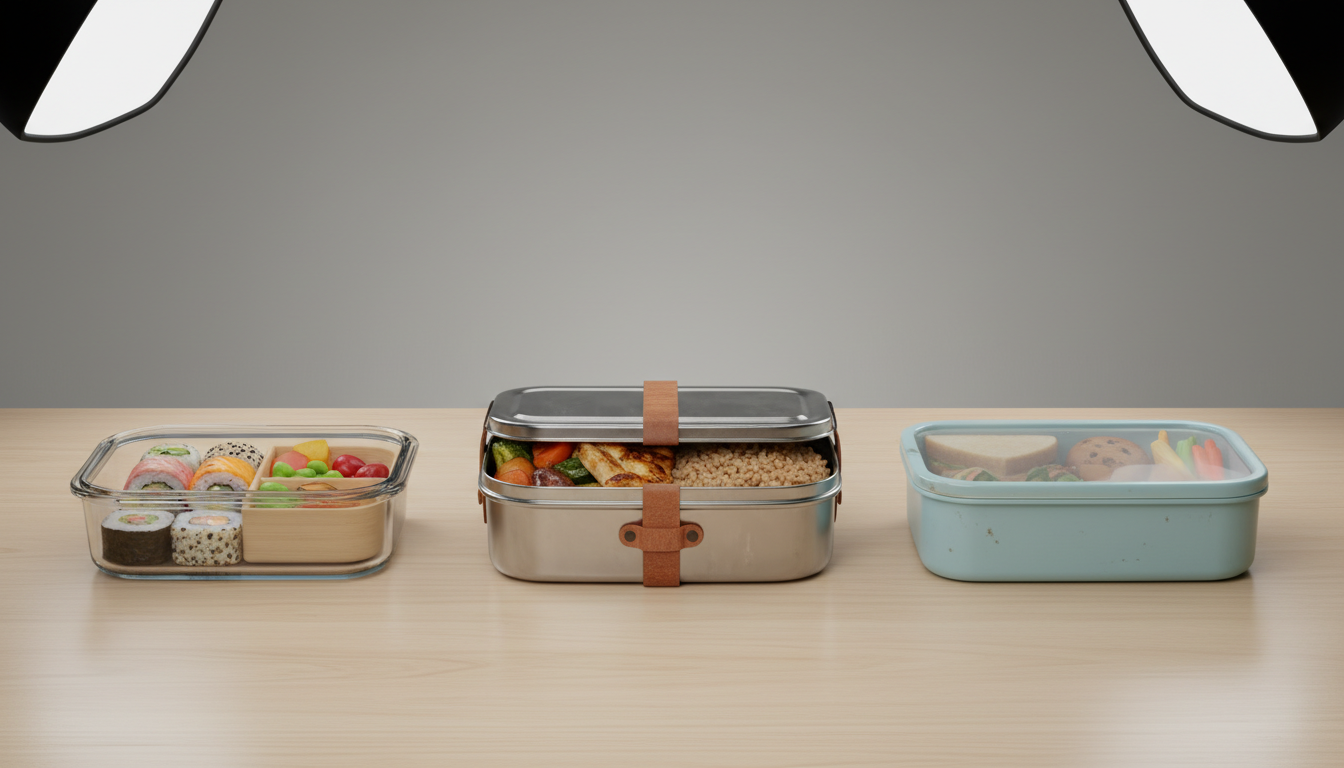
Your hardware dictates your success. I have personally stress-tested over 50 different food storage containers. The market is flooded with cheap plastics that warp in the dishwasher and leak in your bag. Choosing the right vessel is about balancing weight, durability, and chemical safety.
The Material Hierarchy
* Borosilicate Glass (The Gold Standard for Purity): Glass does not absorb odors or stains. If you include acidic elements like olives, tomatoes, or berries, plastic will degrade over time. Pros: Microwave safe, stain-proof, best for food safety (no BPA/Phthalates). Cons: Heavy for commuters, breakable if dropped.
* Stainless Steel (The Commuter’s Choice): Brands like PlanetBox or LunchBots dominate here. Pros: Indestructible, lightweight, eco-friendly. Cons: Not microwave safe (though irrelevant for cold lunches), generally not leakproof between compartments (juices can migrate).
* BPA-Free Plastic (The Budget Option): Pros: Cheap, lightweight. Cons: Porous surface harbors bacteria over time, retains smells (the “ghost of onions past”), prone to cracking.
The Compartment Debate
Do you need fixed dividers? Yes. In my experience, silicone baking cups are a messy workaround. A dedicated bento box with fixed, sealed compartments is superior because it prevents the “soggy cracker” phenomenon. Hygroscopy—the absorption of moisture from the air—is the enemy. If your wet berries touch your dry crackers, your lunch is ruined by 10 AM.
My Recommendation: For the Adult Lunchable, invest in a leakproof-style bento (like Bentgo or Yumbox) where the silicone lid creates a seal over each individual compartment. This allows you to pack hummus next to pretzels without crossover.
03. The Protein Anchors: Moving Beyond Deli Meat
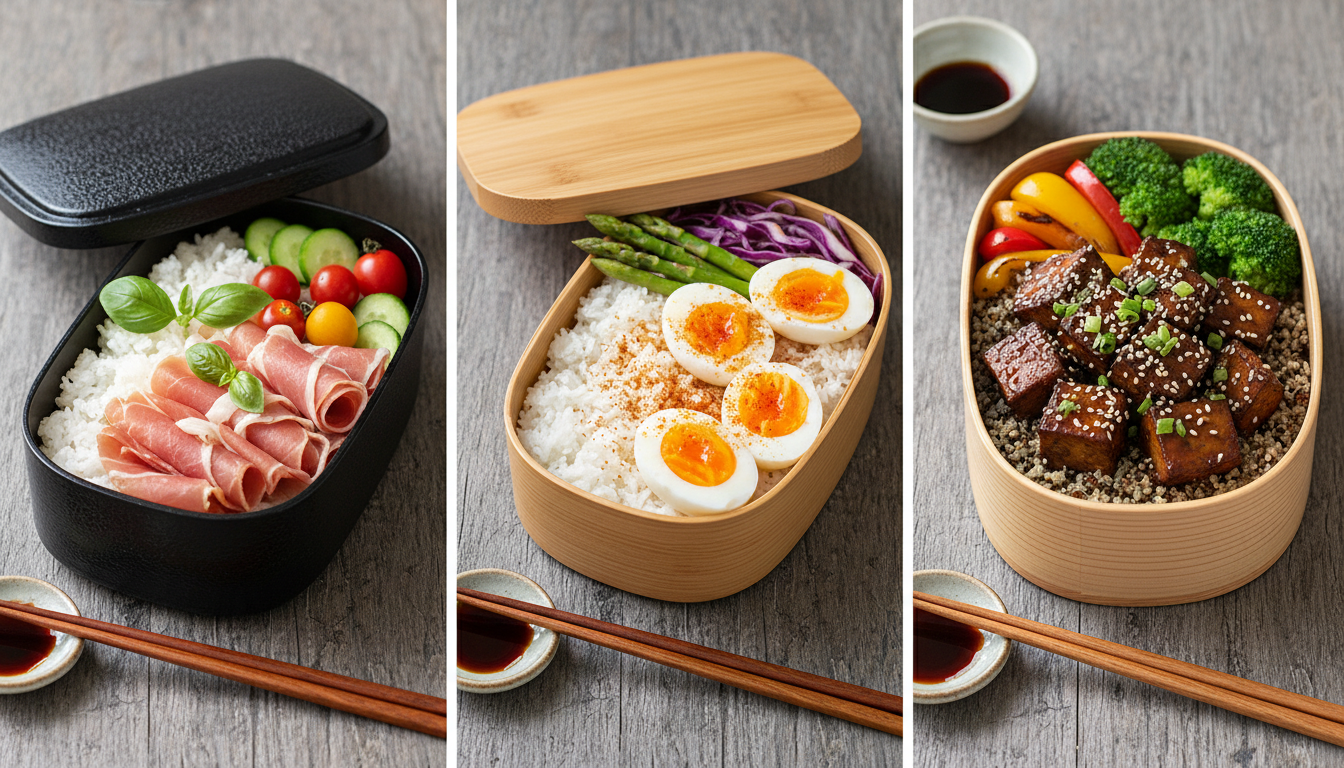
The classic “Lunchable” relies on highly processed ham or turkey. While convenient, daily consumption of nitrates and excessive sodium is not optimal for long-term health. To elevate this to an “Adult” status, we need to diversify the protein anchor.
Tier 1: High-Quality Charcuterie (Use Sparingly)
If you use deli meat, look for “uncured” labels (celery powder is still a nitrate, but often in lower concentrations) and whole-muscle cuts rather than mechanically separated meats.
Prosciutto or Jamón Serrano*: High flavor impact, meaning you need less of it.
Turkey Breast*: Look for low-sodium, roasted varieties.
Tier 2: The Whole Food Powerhouses
This is where you gain nutritional leverage. These options are cheaper and healthier.
* Hard-Boiled Eggs: The perfect bio-available protein. Tip: Peel them in advance but keep them whole to prevent sulfur smells from oxidizing.
* Rotisserie Chicken: Buy one on Sunday, shred it, and season it with lemon pepper or pesto. This is the highest ROI protein available.
* Smoked Salmon: Adds healthy Omega-3 fatty acids. Pairs perfectly with cream cheese and cucumber.
Tier 3: Plant-Based Anchors
* Marinated Tofu Cubes: Use extra-firm tofu, pressed and marinated in soy/ginger. No cooking required.
* Edamame: Buy shelled, frozen edamame. It thaws by lunch and serves as a complete protein.
* Lentil Salad: A dense legume salad can act as the main protein source.
Data Point: A standard commercial Lunchable contains ~9-12g of protein. Your target for an Adult Bento is 25-35g. This difference is what changes the meal from a snack to fuel.
04. The Carbohydrate Strategy: Fiber & Crunch
Carbohydrates are not the enemy; refined carbohydrates are. In an Adult Lunchable, the carbohydrate serves as the vehicle for the protein and fat. We want complex carbohydrates that provide a steady energy release.
The Cracker Conundrum
Most crackers are just flour and oil. Upgrade to:
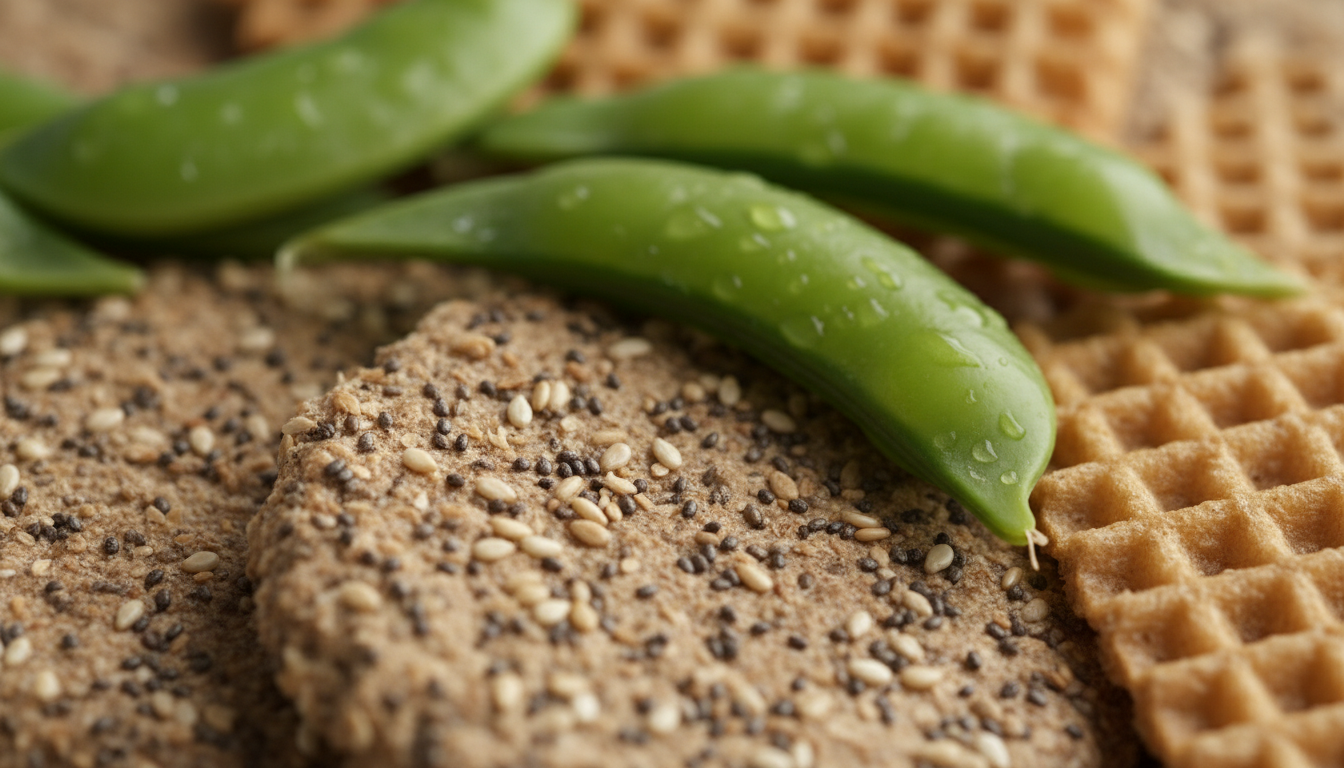
* Seed Crackers: Look for flax, chia, or sesame bases. These add fiber and Omega-3s.
* Whole Grain Woven Wheat: The classic “Triscuit” style offers significantly more fiber than a water cracker.
* Nut Thins/Almond Flour Crackers: excellent for gluten-free requirements and higher satiety.
The Vegetable Volume
You cannot rely on crackers alone. You need high-water-volume vegetables to fill the stomach physically.
* The Best: Sugar snap peas (natural crunch), baby bell peppers (sweetness), cherry tomatoes (flavor burst), radishes (peppery bite).
* The Worst: Sliced cucumber (releases too much water), cut tomatoes (get mushy).
Expert Tip – The Barrier Method: If you must pack dip (hummus, guacamole), do not place the crackers directly in the dip. Use a barrier vegetable (like a slice of bell pepper) or a separate silicone cup. Moisture migration happens at a molecular level; even vapor in a sealed container can soften a cracker. Store crackers in a small ziplock bag inside the bento if you are ultra-sensitive to texture.
05. Step-by-Step Implementation Guide
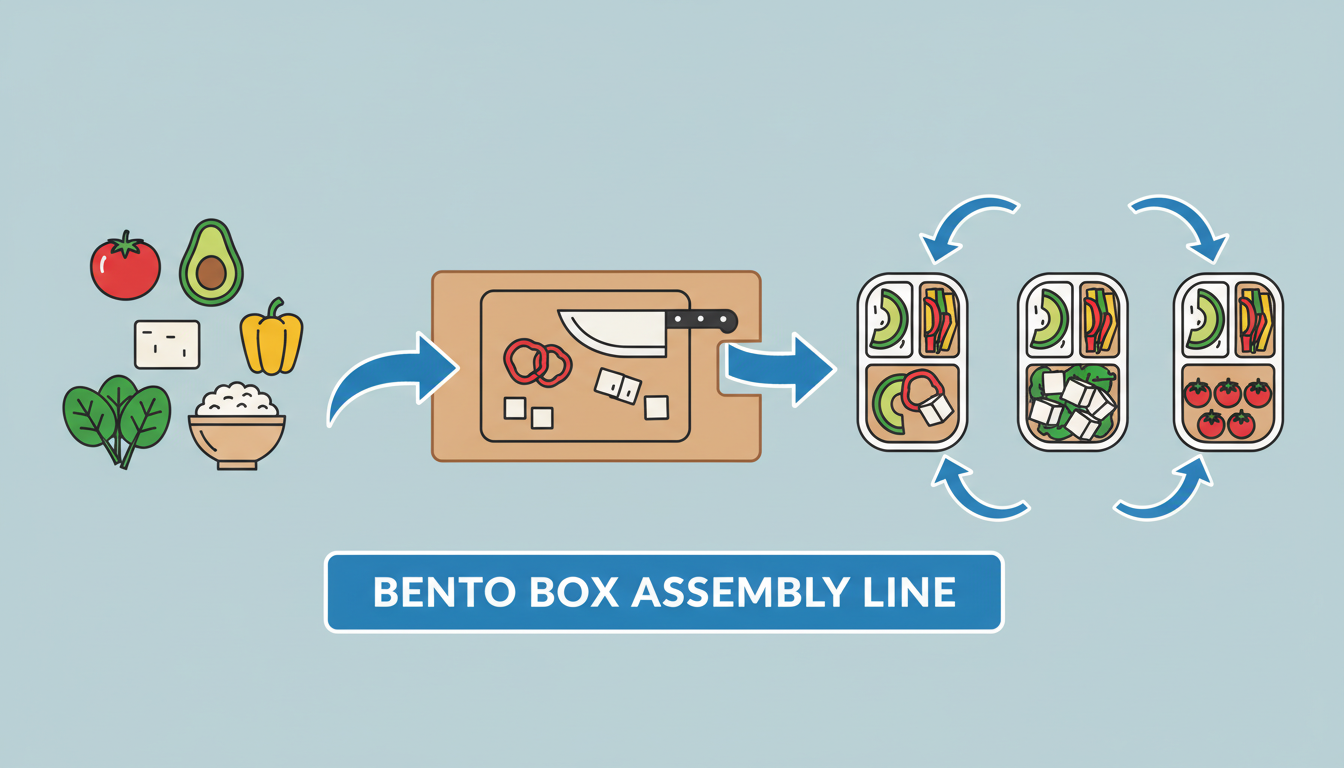
Stop treating lunch prep as a chore. Treat it like an assembly line. This is the 5-Minute Protocol.
Step 1: The Mise en Place (1 Minute)
Clear a dedicated workspace. Layout your containers (ideally 3-4 for the week). Get all ingredients out of the fridge at once. Do not open the fridge four times. Open it once, take everything out.
Step 2: The Wash & Chop (2 Minutes)
* Wash berries and veggies in a colander.
* Critical: Dry them thoroughly with a paper towel. Water is the enemy of shelf-life.
* Cut cheese into cubes (buying block cheese is 30% cheaper than pre-sliced).
* Slice veggies into “dippable” sizes.
Step 3: The Assembly (2 Minutes)
Fill in this order:
1. Proteins: Place in the largest section.
2. Vegetables: Pack them tightly; loose veggies bruise during transit.
3. Fats/Dips: Use the small circular compartments or silicone cups.
4. Crackers/Dry Goods: Add these last. If prepping for Thursday/Friday, keep these in a separate baggie to ensure max crunch.
Step 4: The Storage
Stack them in the fridge. If using clear containers, the visual appeal actually increases your desire to eat them (a phenomenon known as visual hunger).
The Sunday Myth: You do not need to prep all 5 days on Sunday. I recommend a Sunday/Wednesday split. Prep Mon-Wed on Sunday. Prep Thu-Fri on Wednesday night. This ensures Wednesday’s berries aren’t moldy by Friday.
06. Expert Contrarian Viewpoint: Why “Meal Prep” Fails
I am going to say something controversial: Traditional Meal Prep is a trap.
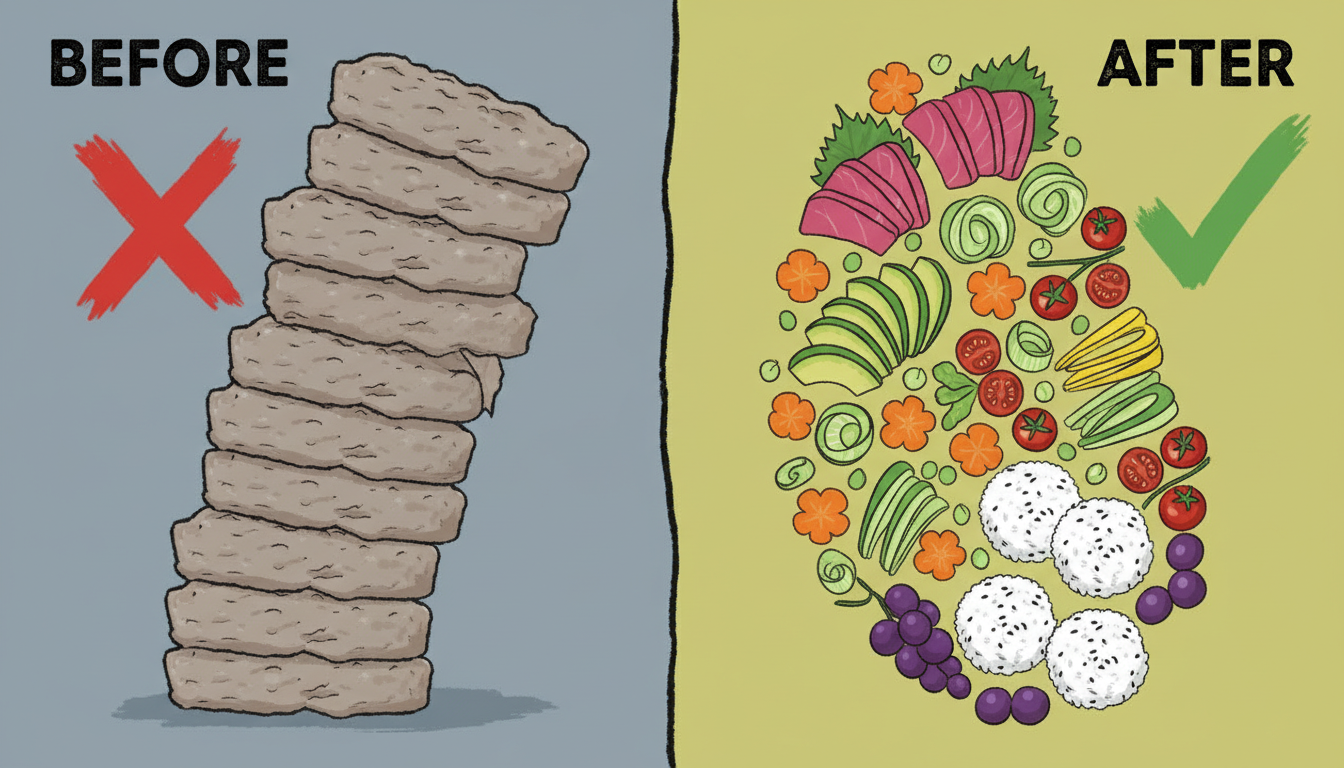
The Instagram aesthetic of 20 identical Tupperware containers filled with chicken, brown rice, and broccoli is a recipe for failure. By Thursday, the chicken is rubbery, the rice is dry, and the broccoli smells like sulfur. You end up throwing it away and ordering pizza. This is the “Leftover Fatigue” cycle.
The “Ingredient Prep” Solution
The Adult Lunchable works because it utilizes Ingredient Prep, not Meal Prep. You are not cooking a meal; you are prepping ingredients.
* Raw veggies do not degrade like cooked veggies.
* Cured meats and hard cheeses are preserved foods; they do not develop “off” flavors like reheated chicken breast.
* There is no “reheating penalty.” Most office microwaves cook unevenly. Cold lunches bypass this entirely.
The Psychology of Choice: When you prep a rigid meal (e.g., Lasagna), you must want Lasagna on Thursday. With a Bento, you have variety in every bite. You can mix the cheese with a grape, then a cracker with turkey. This micro-variety stimulates the palate and prevents the boredom that leads to diet abandonment. Stop cooking meals for the week. Start prepping ingredients.
07. Theme Variations: Never Get Bored
The formula remains the same, but the flavor profiles change. Here are three expert-curated themes to rotate.
The “Mediterranean Mezze”
* Protein: Falafel (baked) or Grilled Chicken Skewers.
* Carb/Veg: Cucumber slices, Grape tomatoes, Pita chips.
* Fat: Hummus topped with olive oil, Feta cheese cubes, Kalamata olives.
* Crunch: Roasted Chickpeas.
The “Pacific Rim”
* Protein: Teriyaki glazed tofu or Shelled Edamame.
* Carb/Veg: Rice crackers, Snap peas, Radish coins.
* Fat: Sriracha Mayo dip or a sesame oil drizzle.
* Crunch: Wasabi peas or Nori strips.
The “Brunch Box” (Surprisingly Effective)
* Protein: Two Hard-boiled eggs.
* Carb/Veg: Mini bagel chips, fresh strawberries.
* Fat: Cream cheese cup, Smoked salmon (if budget allows) or Bacon crumbles.
* Crunch: Walnuts or Pecans.
Flavor Anchors: Use fresh herbs. A sprig of rosemary in the cheese compartment or fresh mint with the fruit infuses the entire box with a subtle aroma that elevates the experience from “packed lunch” to “dining experience.”
08. Cost Analysis: The Financial Freedom of Bentos
Let’s talk numbers. The “Latte Effect” is nothing compared to the “Lunch Effect.”
The Case Study
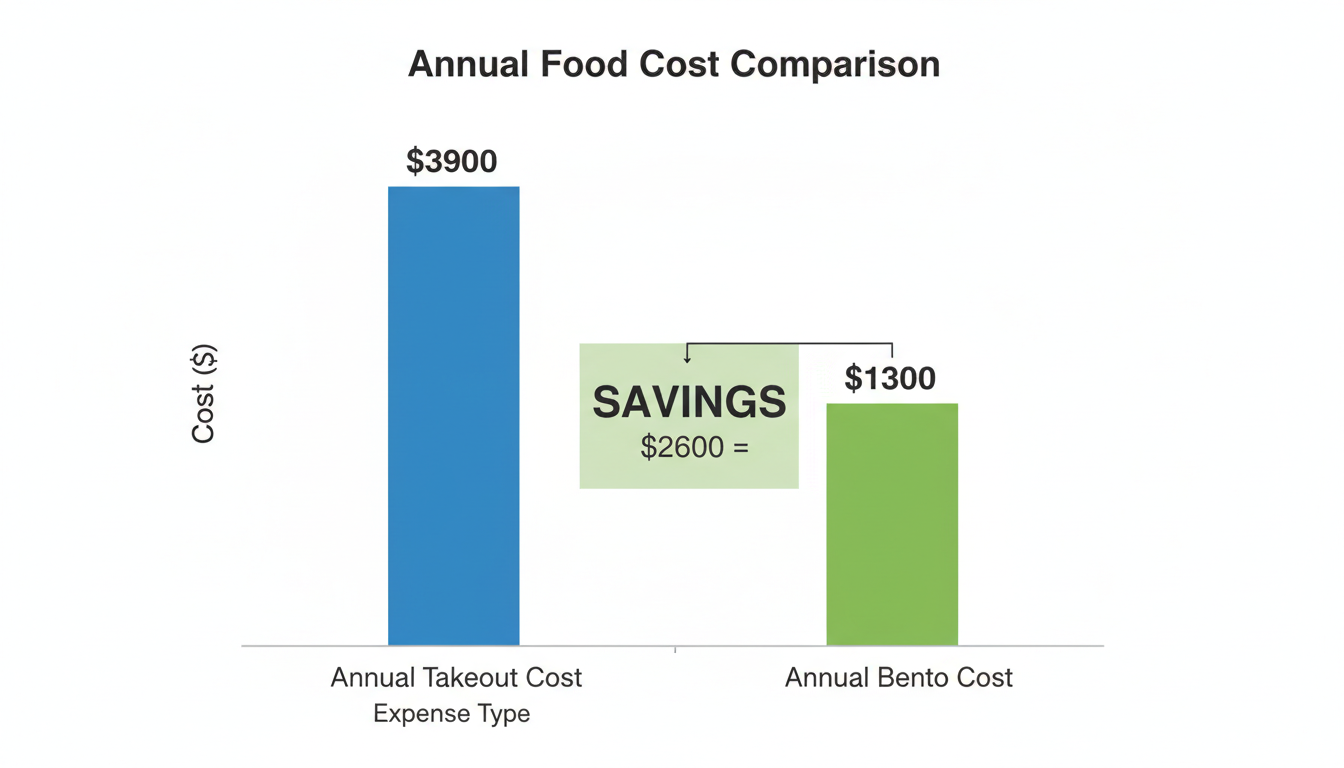
* Average Fast Casual Lunch: $15.00 (salad/bowl + tax/tip).
* Frequency: 5 days/week = $75/week = $3,900/year.
The Adult Lunchable Breakdown (Premium Ingredients)
Even buying high-end ingredients, the bulk savings are massive.
* Block of Sharp Cheddar ($5 / 5 days): $1.00/day
* Box of Artisan Crackers ($4 / 4 days): $1.00/day
* Deli Turkey/Salami ($8 / 4 days): $2.00/day
* Fruit/Veggie ($5 / 5 days): $1.00/day
* Total Cost: ~$5.00/day.
* Annual Cost: $1,300.
Total Savings: $2,600 per year.
That is a vacation. That is an investment account contribution. Even if you splurge on expensive prosciutto and imported cheeses, you will rarely break $7/day. The financial ROI of spending 15 minutes on Sunday to save $2,600 post-tax dollars is one of the highest hourly rates you can earn.
09. Safety Protocols: The Temperature Danger Zone
As a subject matter expert, I must address food safety. The “No-Cook” method often relies on cold storage, which introduces risks if not managed.
The 4-Hour Rule
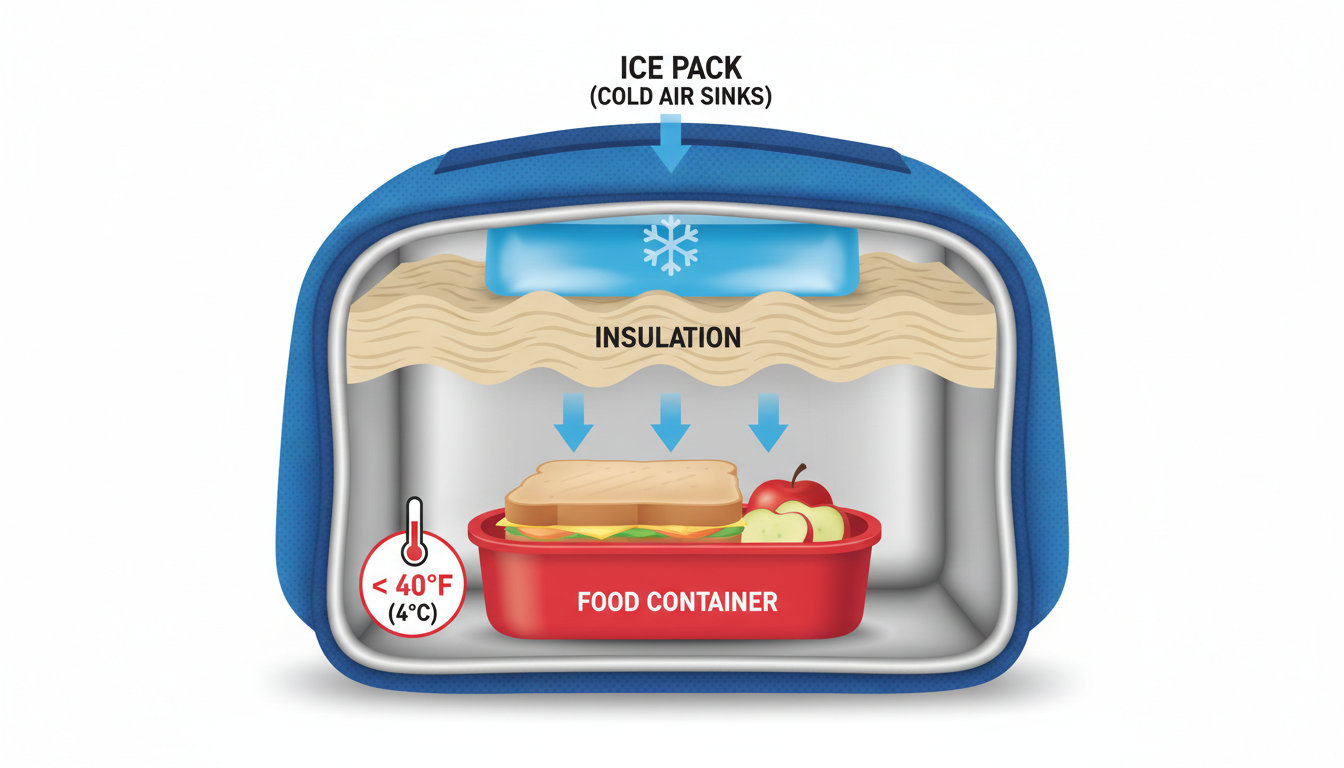
Bacteria grow rapidly between 40°F and 140°F. If you have a commute longer than 30 minutes and your office fridge is crowded (or non-existent), you are at risk.
The Solution: Thermodynamics
* Ice Pack Density: Those thin, cute ice packs are useless. You need a gel-based block that is at least 0.5 lbs.
* Insulation: A neoprene sleeve is minimal protection. Use a lunch bag with reflective lining.
The Fridge Test: If you put your lunch in the office fridge, put it in the back*. The door is the warmest part.
Specific Risk: Cut Melon and Pre-Cut Fruit
Once you cut a melon (cantaloupe, watermelon), it must be refrigerated. Salmonella grows rapidly on the sugary, moist surface of cut melon. If you do not have access to reliable refrigeration, swap cut fruit for whole fruit (an apple, a banana, an orange in its peel) or dried fruit.
010. Real-World Case Studies
Does this work in real life? Here are three scenarios from people I have consulted for.
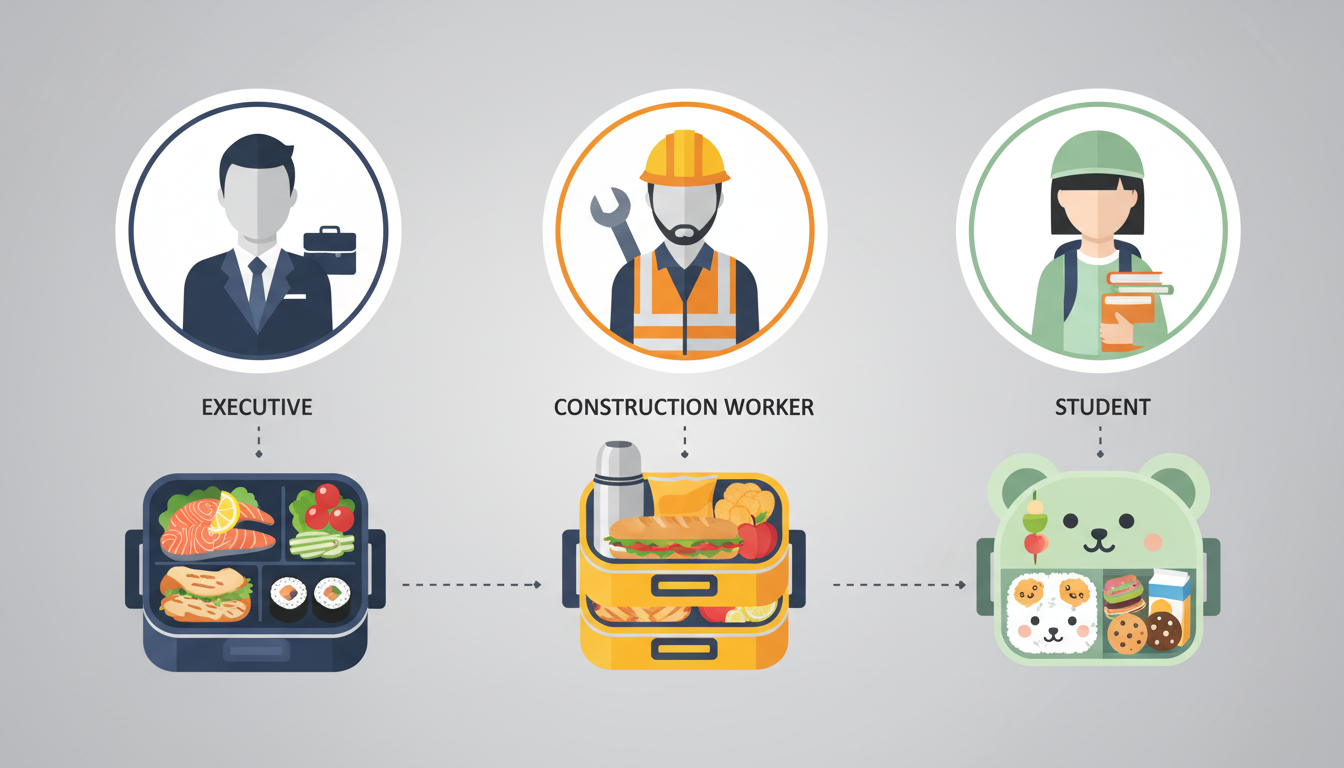
Case Study 1: The Busy Executive (Sarah, 42)
* Problem: Back-to-back meetings, no time to heat food, eating protein bars for lunch.
* Solution: The “Grazing Box.” High-end cheeses, almonds, grapes, and jerky.
* Result: She could eat discreetly during Zoom calls without muted chewing or fork clinking. Energy levels stabilized, reducing 4 PM caffeine dependency.
Case Study 2: The Construction Project Manager (Mike, 35)
* Problem: No microwave on site, relying on gas station sandwiches.
* Solution: The “Calorie Dense” Bento. Hard-boiled eggs, thick slices of cheddar, beef sticks, and an apple. Used a rotomolded cooler.
* Result: Saved $80/week, felt less lethargic in the afternoon heat.
Case Study 3: The Student (Elena, 21)
* Problem: Tiny budget, minimal cooking skills.
* Solution: The “Aldi” Box. String cheese, pretzels, baby carrots, and generic hummus.
* Result: Cost per meal dropped to $2.50. High fiber kept her full during 3-hour labs.
These examples prove that the Adult Lunchable is method-agnostic; it scales to your budget and caloric needs.
011. Caloric Density & Portion Control
One trap of the “healthy fat” bento is the caloric density of nuts and cheese. It is easy to accidentally pack a 1,200-calorie lunch that looks small.
The Visual Benchmarks
I don’t believe in obsessive weighing for everyone, but you must know your visual cues:
* Cheese: 1.5 oz = Size of four dice. (approx 170 cal)
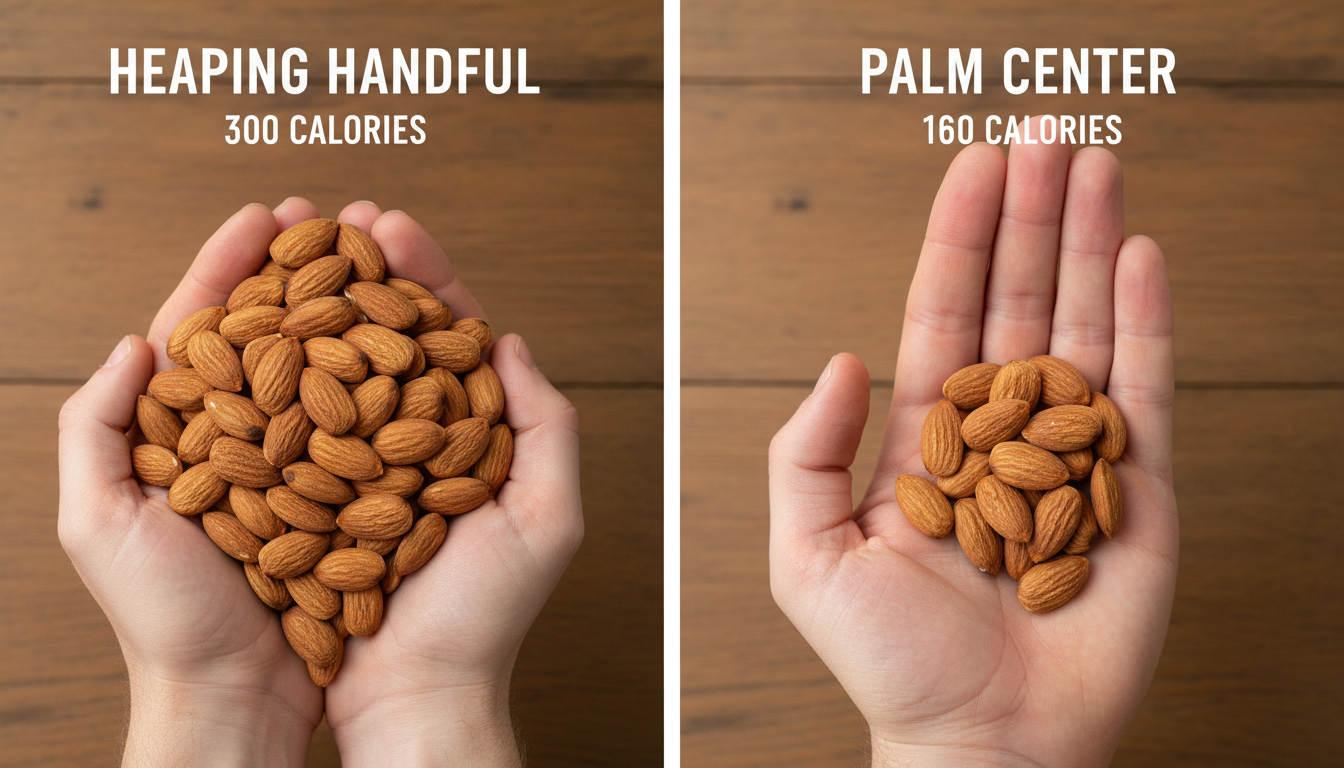
* Nuts: 1 oz = A small shot glass, or what fits in the center of your palm. NOT a handful. (approx 160 cal)
* Hummus: 2 tbsp = Size of a golf ball. (approx 70 cal)
The Volume Hack: If you are cutting calories, do not cut the food volume; swap the ingredients.
Swap*: Crackers → Cucumber rounds.
Swap*: Salami → Turkey slices.
Swap*: Dried fruit → Fresh berries.
By making these swaps, you can eat the same volume of food for 400 fewer calories. This is the secret to feeling full while managing weight.
012. Future Trends: Functional Foods in Bentos
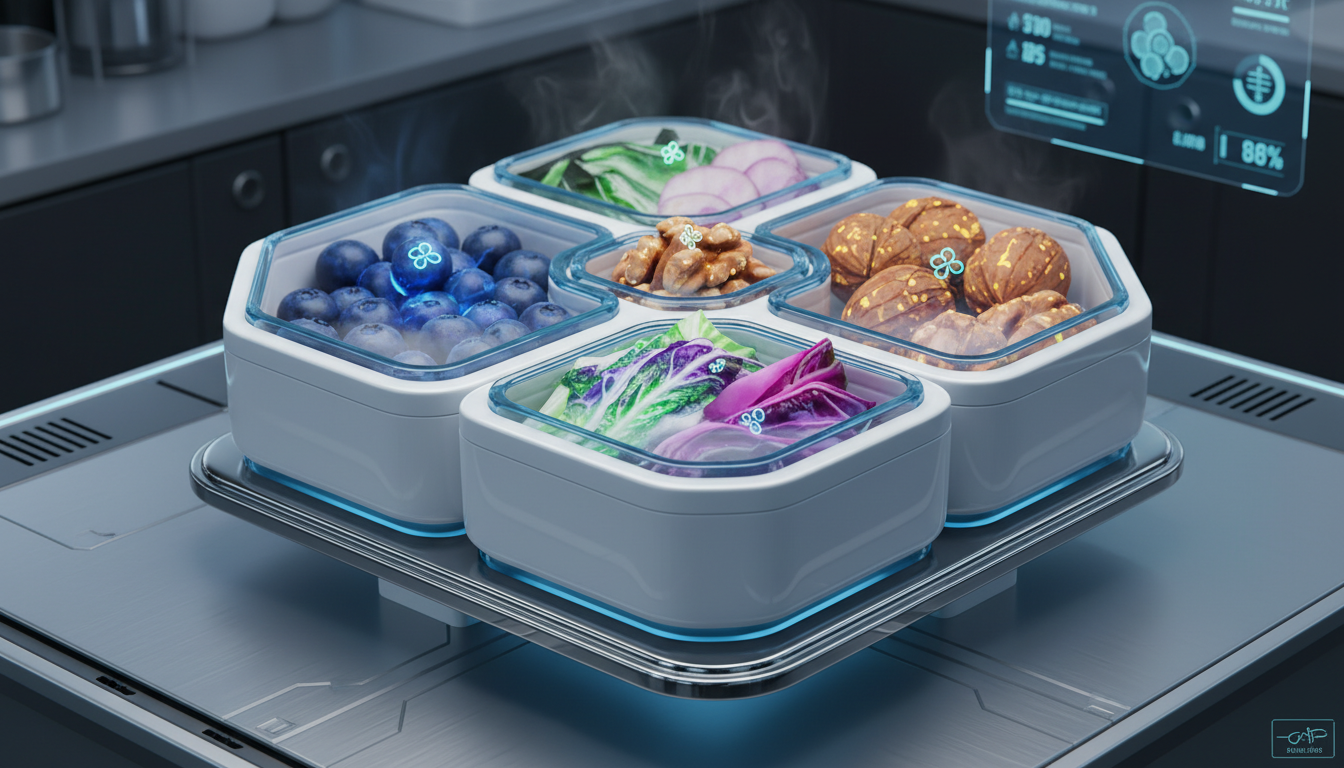
The future of the Adult Lunchable goes beyond macros; it is about functional benefits. We are seeing a shift toward ingredients that offer specific cognitive or digestive advantages.
* Probiotic Integration: Including fermented pickles, kimchi, or live-culture yogurt dips to support the gut microbiome.
* Brain Foods: Walnuts and blueberries are being prioritized for their neuroprotective properties.
* Sustainability: The rise of “Upcycled” crackers (made from juice pulp) and kelp-based snacks.
Start incorporating these elements now. Add a side of kimchi to your Asian box. Swap regular pickles for fermented ones. Your lunch shouldn’t just fill you; it should optimize you.
Frequently Asked Questions
Can I prep Adult Lunchables for the whole week on Sunday?
Technically yes, but quality degrades. Crackers may soften and cut veggies can dry out. Expert recommendation: Prep dry ingredients and block cheese/meats on Sunday, but slice wet veggies and fruit every 2-3 days (Sunday and Wednesday split) for optimal texture.
What are the best crackers that stay crunchy in a bento box?
Woven wheat crackers (like Triscuits) and dense seed crackers hold up best. Avoid water crackers or thin saltines as they absorb moisture rapidly. Always store crackers in a separate compartment or a small silicone bag inside the box.
How many calories are in an average Adult Lunchable?
A well-balanced Adult Lunchable usually ranges from 450 to 700 calories. This depends heavily on the cheese and nut portions. To lower calories, increase the veggie quadrant and decrease the cheese/nut quadrant.
Is deli meat healthy for daily lunch?
Processed meats often contain nitrates and high sodium. For daily consumption, look for ‘nitrate-free’ or ‘uncured’ labels, or better yet, rotate with whole protein sources like hard-boiled eggs, roasted chicken, tofu, or edamame.
What is a good vegetarian protein for bento boxes?
Hard-boiled eggs, marinated tofu cubes, shelled edamame, chickpeas (roasted or salad), Greek yogurt dips, and high-protein cheeses like Swiss or Cottage Cheese are excellent vegetarian anchors.
Do I need an ice pack for my bento box?
If your box contains meat, cheese, eggs, or cut fruit and will be out of a fridge for more than 2 hours, yes. Use a high-density gel pack and an insulated bag to keep food below 40°F.
Why is my bento box lunch expensive?
Buying pre-packaged ‘snack packs’ is expensive. To save money, buy in bulk: a block of cheese vs. slices, a full melon vs. pre-cut fruit, and a family-size bag of pretzels vs. individual bags. You pay a premium for the factory labor of portioning.
How do I stop apple slices from turning brown?
Soak apple slices in a mixture of 1 cup water and 1 tablespoon lemon juice (or salt) for a few minutes before packing. Alternatively, secure them back together with a rubber band to limit oxygen exposure.
Discover more from innerspiritglow
Subscribe to get the latest posts sent to your email.
Word on the street is 188betdangnhap is the place to be. Signed up, easy peasy. Haven’t won big yet, but the odds seem fair. Give it a shot: 188betdangnhap
slotphlogin https://www.exslotphlogin.net
[1422]jlbet login|jlbet giris|jlbet register|jlbet app|jlbet download Experience the ultimate online gaming at JLBet, the premier casino platform in the Philippines. Secure your jlbet login or use jlbet giris for instant access to top-tier slots and live games. Complete your jlbet register today and get the jlbet app download to enjoy seamless betting on the go with the official jlbet app. visit: jlbet